

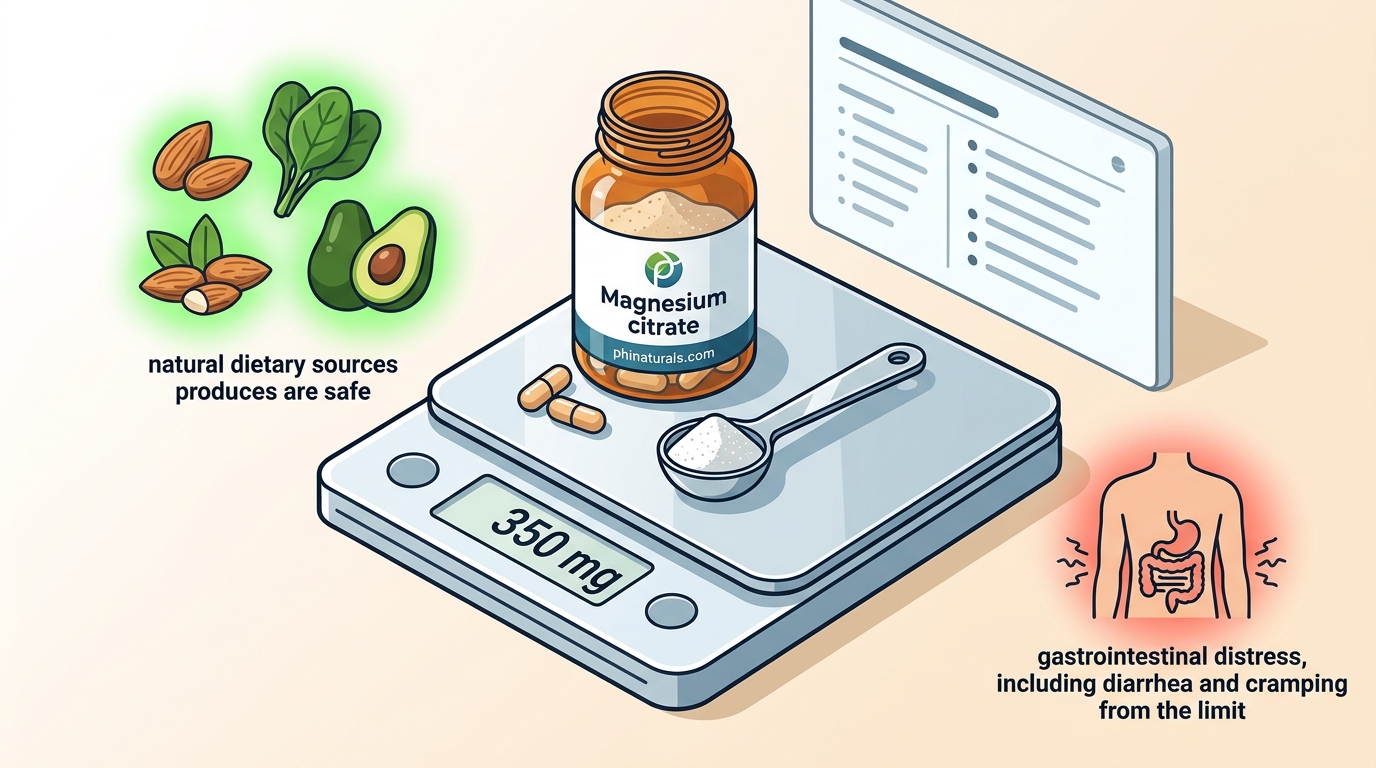
The maximum safe daily amount of magnesium citrate for most healthy adults is 350 mg of supplemental magnesium, according to the National Institutes of Health. This limit applies specifically to magnesium taken from pills, powders, or fortified foods, not from natural dietary sources. Exceeding this threshold can lead to gastrointestinal distress, including diarrhea and cramping, which is the primary safety concern for oral magnesium supplementation.
The NIH Tolerable Upper Intake Level
The National Institutes of Health (NIH) establishes the Tolerable Upper Intake Level (UL) as the maximum daily intake unlikely to cause adverse health effects. For adults aged 19 and older, the NIH sets the UL for supplemental magnesium at 350 mg per day. This figure is distinct from the Recommended Dietary Allowance (RDA), which is 400 to 420 mg per day for men and women, respectively. The RDA includes magnesium from both food and supplements, whereas the UL applies only to the supplemental portion.
It is critical to distinguish between elemental magnesium and the total weight of the magnesium citrate compound. Magnesium citrate contains approximately 11% to 14% elemental magnesium by weight. Therefore, a capsule labeled as 400 mg of magnesium citrate typically provides only about 44 to 56 mg of actual elemental magnesium. To reach the 350 mg supplemental limit, a consumer would need to consume a significantly higher total mass of the citrate salt, not just 350 mg of the compound itself.
Phi Naturals formulates its Magnesium Citrate 400mg Supplement to provide a specific dose of elemental magnesium. Understanding the difference between the salt weight and the active mineral content is the first step in safe dosing. Always check the Supplement Facts panel for the 'Elemental Magnesium' value, not just the total ingredient weight.
Elemental Magnesium vs. Compound Weight
Many consumers make the error of dosing based on the total weight of the magnesium citrate powder or capsule. This is a common mistake because the label often highlights the compound name. Magnesium citrate is a salt formed from magnesium and citric acid. The citric acid portion adds weight but does not contribute to the magnesium intake. Consequently, a 1,000 mg dose of magnesium citrate powder may only yield 110 to 140 mg of elemental magnesium.
For example, if a product label states it contains 400 mg of magnesium citrate, the actual magnesium contribution is roughly 44 mg (assuming 11% bioavailability/elemental content). To hit the 350 mg UL, one would theoretically need to consume over 2,500 mg of the magnesium citrate compound. This distinction is vital for safety. Taking too many capsules based on the compound weight can easily push a user past the safe supplemental limit, leading to digestive issues.
When evaluating products like the supplements collection at Phi Naturals, look for the 'Amount Per Serving' line under the 'Magnesium' heading. This line specifies the elemental amount. If the serving size provides 400 mg of elemental magnesium, that single serving exceeds the 350 mg UL for supplemental intake. In such cases, the user should adjust their serving size or frequency to stay within safe bounds, or consult a healthcare provider.
Gastrointestinal Safety and Side Effects
The primary safety limit for oral magnesium is driven by gastrointestinal tolerance rather than systemic toxicity. Magnesium has an osmotic effect in the intestines, meaning it draws water into the bowel. When intake exceeds the body's absorptive capacity, the unabsorbed magnesium remains in the gut, causing loose stools or diarrhea. This is a self-limiting mechanism; the body essentially flushes out the excess magnesium to prevent accumulation.
If you experience diarrhea or cramping after taking magnesium, it is a sign that you have exceeded your personal tolerance threshold. The implication is simple: reduce the dose. Start with a lower amount, such as half a capsule, and gradually increase it until you find the highest dose that does not cause digestive upset. This personalized approach ensures you stay within the safe window defined by the NIH.
Special Populations and Kidney Function
The 350 mg UL applies to healthy adults. However, specific populations require different considerations. Individuals with kidney disease, particularly those with chronic kidney disease (CKD) stages 3 to 5, have a reduced ability to excrete magnesium. For these individuals, the safe upper limit is significantly lower and must be determined by a nephrologist or healthcare provider. Exceeding the limit in renal impairment can lead to dangerous hypermagnesemia.
Elderly adults may also have reduced renal function, even if it is not clinically diagnosed as CKD. Therefore, older adults should be cautious with high-dose magnesium supplements. Pregnant and lactating women have higher RDA requirements (310 to 360 mg), but the UL for supplemental magnesium remains at 350 mg. This means that while they need more total magnesium, they should not exceed 350 mg from supplements alone, relying on dietary sources for the remainder.
Phi Naturals emphasizes quality and safety in its product formulations. If you fall into a special population, such as having kidney issues or taking medications that affect electrolyte balance, you should consult your physician before starting any new supplement regimen. The About Us page highlights the company's commitment to product quality, but individual medical needs always take precedence over general guidelines.
Practical Dosing Strategies for Daily Wellness
To safely incorporate magnesium citrate into your daily routine, start with a low dose and titrate upward. A common strategy is to begin with 100 to 200 mg of elemental magnesium per day. Monitor your digestive response for one to two weeks. If no side effects occur, you can increase the dose by 100 mg increments every few days until you reach your target or the 350 mg limit.
Timing can also affect tolerance. Taking magnesium with food may slow absorption and reduce the likelihood of diarrhea compared to taking it on an empty stomach. Splitting the daily dose into two smaller doses (e.g., morning and evening) can also improve absorption and minimize gastrointestinal side effects. For instance, taking 175 mg in the morning and 175 mg in the evening is less likely to cause issues than taking 350 mg at once.
When selecting a product, consider the form and concentration. The Magnesium Citrate 400mg Supplement from Phi Naturals is designed to be a convenient daily option. However, always verify the elemental content on the label. If the product provides 400 mg of elemental magnesium per serving, you should take only a fraction of that serving to stay within the 350 mg UL, or choose a lower-dose product. Consistency is key; daily, moderate dosing is safer and more effective than occasional high-dose loading.
Key Takeaways
- The NIH sets the Tolerable Upper Intake Level (UL) for supplemental magnesium at 350 mg per day for adults.
- Magnesium citrate contains only about 11% to 14% elemental magnesium, so the compound weight is much higher than the active dose.
- Always check the Supplement Facts panel for 'Elemental Magnesium' to determine your true intake.
- Diarrhea is the primary sign of exceeding your personal magnesium tolerance; reduce the dose if this occurs.
- Individuals with kidney disease have a much lower safe limit and must consult a healthcare provider before supplementing.
- Splitting the daily dose into two smaller servings can improve absorption and reduce gastrointestinal side effects.
- Start with a low dose (100-200 mg) and titrate upward to find your personal safe maximum.
Frequently Asked Questions
What is the maximum safe daily amount of magnesium citrate?
The maximum safe daily amount of supplemental magnesium is 350 mg for healthy adults. Since magnesium citrate is about 11-14% elemental magnesium, this translates to roughly 2,500 mg of the magnesium citrate compound. Always check the label for elemental magnesium content.
Can I take more than 350 mg of magnesium if I eat a magnesium-rich diet?
The 350 mg limit applies only to supplemental magnesium (pills, powders, fortified foods). There is no established UL for magnesium from natural food sources. You can consume more than 350 mg total if the excess comes from food, but you should not exceed 350 mg from supplements alone.
What happens if I take too much magnesium citrate?
The most common side effect of taking too much magnesium citrate is diarrhea. This is a self-limiting response where the body flushes out the excess mineral. In rare cases, especially in people with kidney issues, it can lead to hypermagnesemia, which causes nausea, low blood pressure, and cardiac issues.
How much magnesium citrate is in a 400 mg capsule?
A 400 mg capsule of magnesium citrate typically contains only about 44 to 56 mg of elemental magnesium, depending on the specific formulation. The rest of the weight is citric acid. To reach the 350 mg supplemental limit, you would need to take many such capsules, which is not recommended without medical supervision.
Is magnesium citrate safe for people with kidney disease?
People with kidney disease should be very cautious with magnesium supplements. Their kidneys may not be able to excrete excess magnesium, leading to dangerous buildup. The safe limit for these individuals is much lower than 350 mg and must be determined by a healthcare provider.
Should I take magnesium citrate with food or on an empty stomach?
Taking magnesium citrate with food can help reduce the likelihood of diarrhea and improve tolerance. It may also slow absorption, which can be beneficial for those sensitive to the osmotic effect of magnesium in the gut.
Conclusion
Understanding the maximum safe daily amount of magnesium citrate requires distinguishing between the compound weight and the elemental magnesium content. The NIH sets the supplemental limit at 350 mg per day for healthy adults, a threshold designed to prevent gastrointestinal distress. By carefully reading labels, starting with low doses, and adjusting based on your body's response, you can safely incorporate magnesium into your wellness routine. For high-quality, transparently labeled options, explore the full product range at Phi Naturals to find a formulation that fits your specific needs and safety profile.