

The Mechanics of Dissolution and Disintegration
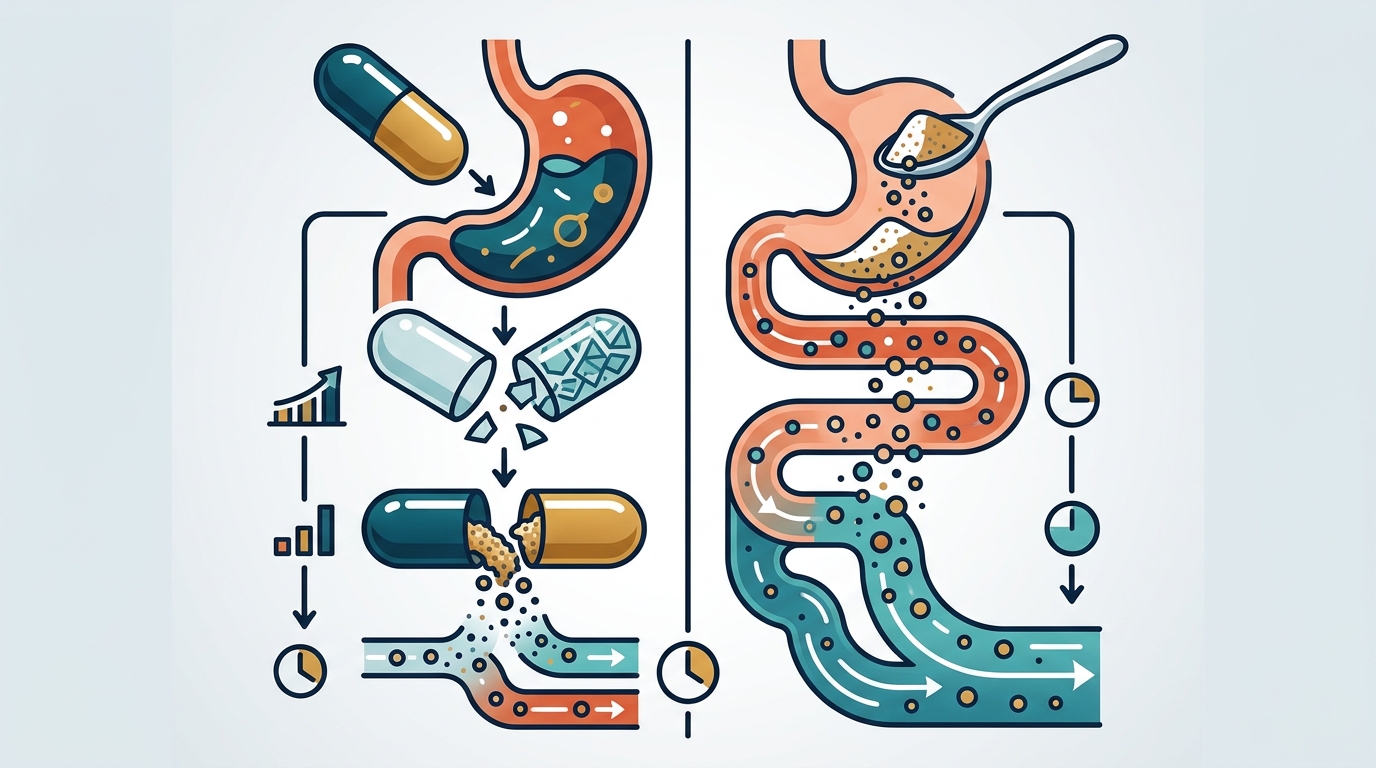
To understand absorption speed, one must first define the process of disintegration. Disintegration is the breakdown of a solid dosage form into smaller particles, which is a prerequisite for the active ingredients to dissolve in gastrointestinal fluids. Capsules, particularly those made from gelatin or hydroxypropyl methylcellulose (HPMC), must first undergo this disintegration phase before the contents can be absorbed. In contrast, loose powders are already in a particulate state, meaning they skip the initial shell-breaking step entirely. For additional details, review the Collections ndash PhiNaturals.
This mechanical advantage gives powders a theoretical head start. When a capsule enters the stomach, the acidic environment and mechanical churning work to break down the shell. This process can take anywhere from a few minutes to over an hour, depending on the shell's thickness and the formulation's binding agents. Once the shell breaks, the powder inside is released and begins to dissolve. For a loose powder supplement, the particles are immediately exposed to gastric juices, allowing dissolution to begin almost instantly upon ingestion. This distinction is critical for users seeking rapid onset of effects, as the time to peak plasma concentration (Tmax) is directly influenced by how quickly the active compound becomes available in solution. For additional details, review the Products ndash PhiNaturals.
Ingredient-Specific Absorption Dynamics
While the physical form matters, the chemical nature of the ingredient often dictates the final absorption rate. Water-soluble compounds, such as certain vitamins and minerals, tend to dissolve rapidly regardless of whether they are in a capsule or powder. For these substances, the difference in absorption speed between the two forms is negligible. However, fat-soluble compounds, like Vitamin K2 or certain herbal extracts, require the presence of dietary fats and bile salts for efficient absorption. In these cases, the delivery vehicle matters less than the meal composition. For additional details, review the Supplements ndash PhiNaturals.
Consider the example of magnesium citrate. Magnesium is an inorganic mineral that must be dissolved in water to be absorbed in the small intestine. A loose powder of magnesium citrate will dissolve in the stomach fluid much faster than a capsule containing the same mineral. This rapid dissolution can lead to a quicker rise in serum magnesium levels. Conversely, for complex herbal blends, the matrix of plant fibers and other compounds may slow down the release of active alkaloids or flavonoids, regardless of the dosage form. Therefore, the "speed" of absorption is not a universal constant but a variable dependent on the solubility profile of the specific supplement.
Impact of Gastric Emptying and Digestive Health
The rate at which the stomach empties its contents into the small intestine is a major bottleneck for absorption. Gastric emptying is the process by which food and liquids move from the stomach to the duodenum. Powders, being semi-liquid when mixed with water, typically empty from the stomach faster than solid capsules. This is because the stomach treats liquids and semi-liquids differently than solid objects. A capsule is a solid object that must be broken down before its contents can pass through the pyloric sphincter. A powder mixed in water forms a slurry that can pass through more quickly.
Practical Implications for Daily Supplementation
For most daily maintenance supplements, the slight speed advantage of powders is not clinically significant. The human body is designed to handle a wide range of ingestion speeds, and the difference between a 30-minute and a 60-minute absorption window rarely impacts long-term health outcomes. However, for performance-enhancing supplements or acute stress management, the speed of onset may be a priority. In these scenarios, powders or liquid formulations may be preferred to achieve a quicker physiological response.
Key Takeaways
- Loose powders generally absorb faster than capsules because they bypass the capsule disintegration step.
- The absorption speed of water-soluble ingredients is less affected by dosage form than fat-soluble ingredients.
- Gastric emptying rate is a major determinant of how quickly a supplement reaches the small intestine.
- For daily maintenance, the difference in absorption speed between capsules and powders is often negligible.
- Individual digestive health, such as gastroparesis, can significantly impact the relative speed of capsule absorption.
- Convenience and taste preferences should also be considered when choosing between capsules and powders.
Frequently Asked Questions
Do capsules always absorb slower than powders?
No, not always. For highly water-soluble ingredients, the difference in absorption speed between capsules and powders is minimal. The capsule shell adds a small delay, but the active ingredient dissolves quickly once the shell breaks.
What is the main factor that determines absorption speed?
The solubility of the active ingredient is the primary factor. Water-soluble compounds absorb quickly regardless of form, while fat-soluble compounds depend on dietary fat and bile for absorption.
Can I take a capsule with water to speed up absorption?
Drinking water with a capsule can help it move through the esophagus and into the stomach, but it does not significantly speed up the disintegration of the capsule shell itself.
Are there any downsides to using powders for faster absorption?
How long does it take for a capsule to dissolve in the stomach?
It typically takes between 15 minutes and one hour for a standard gelatin capsule to disintegrate in the stomach, depending on the shell material and formulation.
Does taking a supplement with food affect absorption speed?
Yes, taking a supplement with food can slow gastric emptying, which may delay the absorption of both capsules and powders. However, food can enhance the absorption of fat-soluble nutrients.